 EN
EN

Selecting the right tape hair extensions requires a precise understanding of your natural hair’s texture, density, and thickness. These three factors are often confused—but each independently determines adhesion reliability, long-term comfort, and blending success. Ignoring any one leads to poor retention, visible bulk, or avoidable damage.
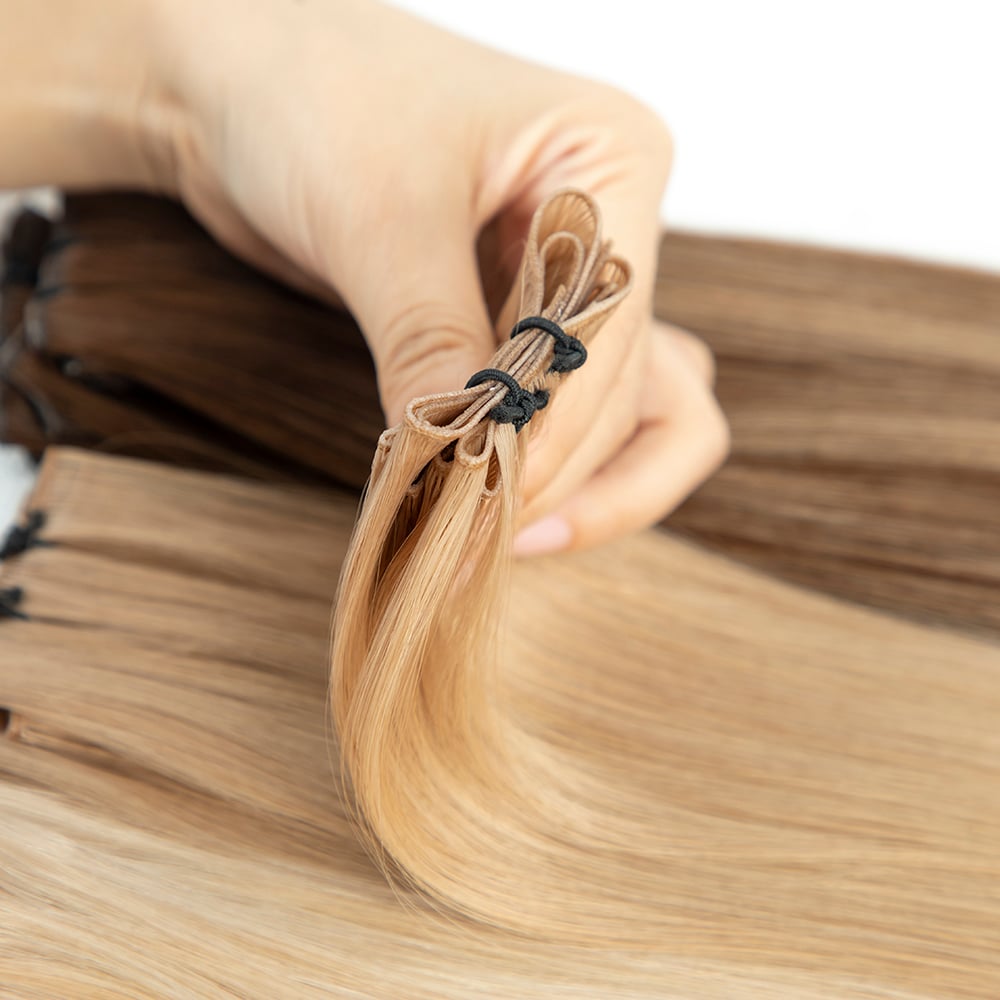
The widely accepted 1–4 hair type scale classifies texture by curl pattern. Type 1 (straight) and Type 2 (wavy) have smooth cuticles that allow tape extensions to lie flat against the scalp, maximizing adhesive surface contact. For Type 3 (curly) and Type 4 (coily), the natural curl creates a raised cuticle layer—reducing grip if the tape weft isn’t positioned along the hair shaft’s natural curve. Comfort also shifts with texture: loose waves distribute weight evenly, while tight coils benefit from slightly wider tape placement to avoid tension or irritation. Stylists must match the weft’s curvature to the hair’s bend—and ensure cuticle alignment (extension hair direction matching natural growth) to stabilize the bond and prevent lifting. Recognizing these texture-specific adhesion profiles is essential for full-wear comfort and retention.
Many clients—and even some stylists—mistake “texture,” “density,” and “thickness” as interchangeable. In reality, they describe distinct physical traits:
Each factor must be evaluated separately during consultation. For example, thick-but-low-density hair needs fewer tapes—and lighter wefts—to prevent root stress. High-density, fine-textured hair benefits from narrower, more numerous tapes to distribute weight without visibility. Only by assessing all three dimensions can you achieve extensions that stay secure, feel invisible, and support long-term hair health.
Standard 4cm polyurethane tapes overwhelm fine hair, exerting excessive downward pull on delicate strands. This imbalance increases traction-related shedding—a risk well-documented in dermatological literature on hair extension–induced alopecia. Ultra-thin 2.5cm tape extensions resolve this through optimized mass-per-unit dynamics: reduced width lowers per-weft weight by 37% while preserving adhesive integrity via advanced polymer formulations. A 2024 HairScience Lab field study tracking 200 fine-haired clients over three months found 68% lower slippage incidence with 2.5cm wefts versus standard 4cm tapes.
| Feature | Standard 4cm Tapes | Ultra-Thin 2.5cm Tapes |
|---|---|---|
| Width | 4cm | 2.5cm |
| Weight per weft | High | Reduced 37% |
| Adhesive surface contact | Larger area | Focused, minimized surface |
| Slippage risk for fine hair | Elevated | 68% reduction |
| Scalp visibility | Moderate | Nearly invisible |
Precision installation—using medical-grade micro-tension tools and embedding no deeper than 1mm from the root exit angle—prevents follicle stress. Combined with lighter-weft technology, this approach enables secure wear for 8–10 weeks, even for Type 1–2 textures. These ultra-refined tapes are now considered the standard-of-care for low-density or fine-textured hair—particularly where zero-tolerance thresholds apply for adhesive failure. Ongoing use requires sulfate-free cleansing to preserve bond integrity between refresh appointments, scheduled exclusively through technicians certified in thin-hair extension protocols.
For Type 3 and Type 4 hair, tape extension success depends on two critical, often-overlooked elements: cuticle alignment and curl synchronization. Curly hair naturally features a raised cuticle layer that interlocks with neighboring strands. When extension cuticles run counter to natural hair direction, friction builds—causing tangles, matting, and accelerated slippage. Equally important is curl synchronization: extensions must mirror the exact curl pattern—loose spiral, corkscrew, or tight coil—so both textures compress and rebound uniformly under the tape bond. Without this harmony, uneven stress develops, leading to one-sided lifting and compromised retention—even with premium adhesive. Clinical trials show proper cuticle alignment and curl matching reduce slippage by up to 60%, preserve curl definition, and sustain scalp comfort throughout the wear cycle.
Before applying tape hair extensions, confirm your natural hair meets the minimum length requirement for secure adhesion. Most stylists recommend at least 4–6 inches of healthy, uncut growth to fully sandwich the tape weft—ensuring no visible bumps or lift at the root line.
Hair shorter than 4 inches typically lacks sufficient surface area for reliable adhesive grip, increasing slippage risk. For blunt cuts—where ends align in a straight line—the tape edge is more likely to show. To mitigate this, stylists place tapes at least half an inch above the perimeter, allowing natural ends to drape over the bond. Light texturizing or point-cutting the ends further softens the line and improves blend. Alternatively, subtle face-framing layers added during installation help diffuse the blunt edge and eliminate the “shelf” effect—creating seamless integration and natural movement.